



Discover how meditation can change your experience of the world.
Listen
Series
The Introductory Course
Sam Harris
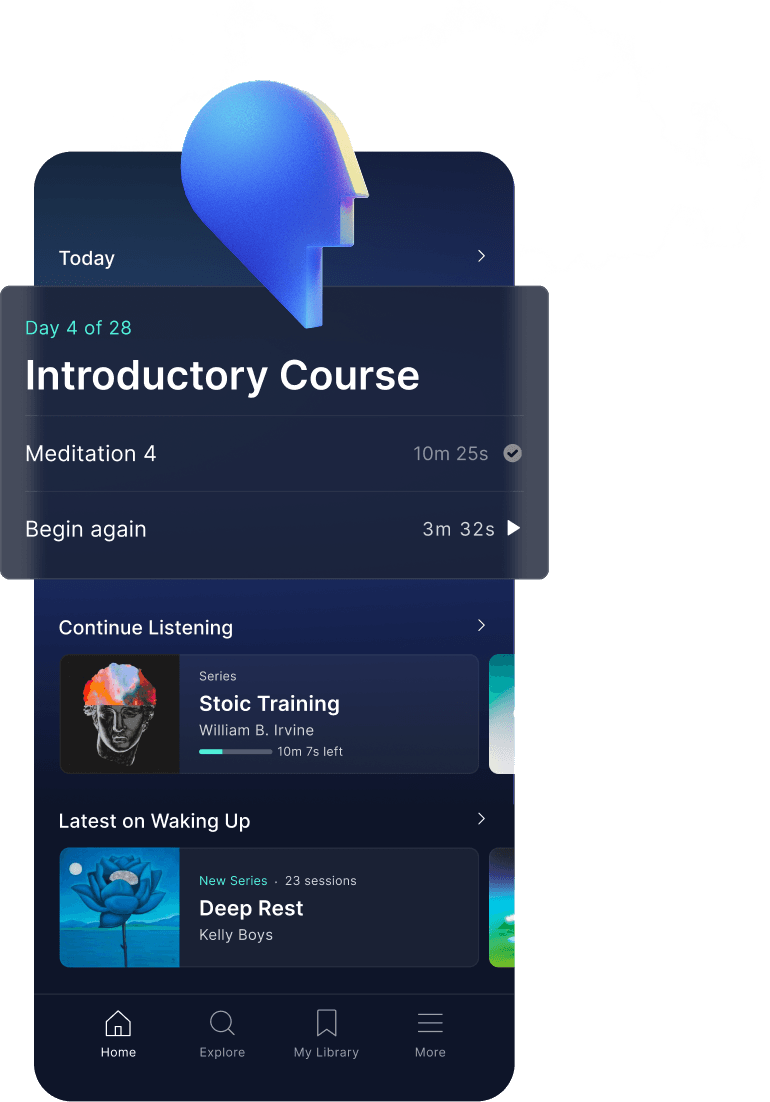
Waking Up is more than a meditation app. It’s designed to help you have fundamental insights into the nature of your own mind. Waking Up takes a rational, secular approach to meditation, so you can understand what you’re practicing and why it matters.
Discover how meditation can change your experience of the world.
Listen
Series
Sam Harris

Learn to recognize the “spacious nature of impersonal, open awareness.”
Listen
Series
Jayasāra

Investigate the fleeting yet infinitely rich character of the present moment.
Listen
Series
John Astin

Develop a more intuitive mindfulness practice, as you explore various levels of awareness.
Listen
Series
Diana Winston

Guided meditations to help you experience deep relaxation and rest.
Listen
Meditation
Jayasāra & Jitindriya

Sam, Dan, and Joseph discuss different meanings of nonduality across Buddhist traditions.
Listen
Conversation
Dan Harris, Joseph Goldstein & Sam Harris

Simple and uncommon exercises to reveal what’s hidden in plain sight.
Listen
Lesson
Rob Walker
Let content themes guide your journey and discover sessions and conversations about different life experiences.
Meditation is a way of training attention. At its core, it’s simply noticing your thoughts as they arise and pass, giving yourself space to observe them without getting pulled into judgment or provoked to reaction.
Anxiety, worry, and stress typically emerge out of repetitive thinking that’s rooted in resistance to what’s perceived as happening.
Life transitions are periods when familiar roles, identities, or expectations begin to shift. These changes—whether welcome or difficult—often unsettle how we understand ourselves by exposing hidden beliefs and habits.
Sleep is a natural biological process, not something you can force or optimize into existence. Meditation can change how you relate to wakefulness, restlessness, and the effort that often keeps sleep at bay.
Psychedelics can produce dramatic changes in consciousness, often making experience feel more open, fluid, or less centered around a fixed sense of self.
Learn from Zen, Dzogchen, Vipassana, Advaita, Stoicism, and other traditions, without the dogma.
Vipassana is a method of closely examining your thoughts, emotions, and sensations. These appearances constitute your experience in every moment, and they’re constantly arising, changing, and dissolving in awareness.
Zen is a Buddhist tradition centered on direct experience in everyday life. Through seated meditation and close attention to ordinary activities, Zen practices invite you to meet experience as it is.
Stoicism is a practical philosophy focused on distinguishing what you can control from what you can’t. It aims to reduce unnecessary suffering, increase resilience in everyday life, and prioritize what really matters.
Modern psychology and neuroscience study how thought, emotion, and behavior arise from the brain and mind. Waking Up draws on these fields to explain why we struggle, how patterns form, and what actually supports meaningful change.
Through stories, images, music, and language, arts and literature give form to experience, revealing patterns that feel simultaneously personal and universal.

Sam Harris is a neuroscientist, philosopher, five-time New York Times bestselling author, and creator of the Waking Up app. He has practiced meditation for over 30 years and has studied with Tibetan, Indian, Burmese, and Western meditation teachers across the world.
Learn More
Andrew Huberman
Stanford neuroscientist, host of The Huberman Lab podcast
New to meditation? Start with our comprehensive Introductory Course, which combines daily meditation with short lessons on the theory behind the practice. Or choose from a range of other ways to practice with Waking Up.
Join 50,000+ Waking Up members across 26 countries in our private forum, with opportunities to discuss the ideas and practices in the app and to connect in person.
Waking Up combines meditation training with insights from neuroscience, philosophy, and psychology.
Alongside guided practice, you'll explore lessons and conversations that help you better understand your mind and how to live with more clarity, awareness, and purpose.
Both.
The app includes a step-by-step Introductory Course for beginners, along with deeper theory lessons, longer practices and more advanced conversations for experienced meditators.
Start where you feel comfortable, and move forward at your own pace.
No.
Waking Up takes a secular approach to meditation. No beliefs, ideology, or spiritual commitments are required—only a willingness to examine your own experience.
Many people use Waking Up to better understand stress, anxiety, anger, and other difficult emotions.
Rather than offering quick fixes, the app teaches practical skills for working with your mind so you can respond to life's challenges with more clarity and less reactivity.
Waking Up is available through an annual subscription after a .
Your membership includes full access to the entire library of meditations, lessons, conversations, and new content released regularly.
We offer a free membership to anyone who can't afford Waking Up.
If cost is a barrier, you can request a scholarship and get full access to the app—no questions asked.
Yes.
Members can join the private Waking Up Community to discuss meditation, share insights, and connect with others interested in living more examined lives. The forum includes discussions, local meetups, and opportunities to continue the conversation beyond the app.
Yes.
You can cancel your subscription at any time through your account settings. Your access will continue through the end of your billing period.
If you're not satisfied, you can also contact support to request a refund.

Daily Meditation
A new guided session from Sam Harris on the home screen every day. You’ll never do the same practice twice in a row. Or, if you prefer unguided meditation, use the unguided timer, choose a background sound, or just sit in silence.

Moments & Daily Wisdom
Short pieces of guidance and quotes from Sam Harris and other teachers, for when you don’t have time for a full meditation.

Playlists
Build your own sequence of sessions. Keep it private, or share it with a friend.

Archival Recordings
Decades of talks from teachers like Alan Watts and Joseph Goldstein, preserved and searchable in the app.
Daily Meditation
A new guided session from Sam Harris on the home screen every day. You’ll never do the same practice twice in a row. Or, if you prefer unguided meditation, use the unguided timer, choose a background sound, or just sit in silence.
Moments & Daily Wisdom
Short pieces of guidance and quotes from Sam Harris and other teachers, for when you don’t have time for a full meditation.
Playlists
Build your own sequence of sessions. Keep it private, or share it with a friend.
Archival Recordings
Decades of talks from teachers like Alan Watts and Joseph Goldstein, preserved and searchable in the app.